On 2 April 1993 Philip Morris announced a 20% price cut on Marlboro, to fight back against unbranded cigarettes that were eating into its market share. In a single day the share price lost around a quarter of its value and dragged down other major brands such as Coca-Cola. The financial press announced the end of the brand: after the early-1990s recession, consumers seemed to prefer price over name. The day went down in history as Marlboro Friday.
The brand did not die; it changed shape. In the years that followed, brands such as Gap, Apple and Starbucks entered people’s daily lives by selling not just products but a way of living, and they did so through their stores too.
More than thirty years later the pattern seems to be repeating. Consumers are once again weighing price against real value, Uniqlo is growing while the great luxury houses slow down, and the logo is losing power: in the 2026 BCG-Altagamma study of 10,000 luxury consumers, logo visibility ranks last among purchase drivers in every category analysed. The thesis of this article is that brands are responding as they did then, by shifting value elsewhere. In the 1990s from product to lifestyle, today towards physical space: the store, the café, the flagship, the experience that no cheaper copy can replicate.
Physical space is not disappearing: its function is changing. For anyone who designs stores, understanding this change is the starting point of every new concept.
LUXURY AND THE CRISIS OF PERCEIVED VALUE
In the third quarter of 2026, LVMH’s fashion and leather goods division, the core of the group that controls Louis Vuitton and Dior, saw sales fall by 5%, well beyond analysts’ expectations. Since the start of the year the share price has lost around 40% of its value. China weighs heavily: Chinese consumers account for roughly a fifth of global luxury purchases and have cut spending both at home and abroad.
But China explains only part of the crisis. According to the BCG-Altagamma luxury consumer study, 70% of shoppers gave up at least one purchase in the last twelve months because they considered the price unjustified. After years of price increases, price alone no longer makes a product desirable. The same study finds that 56% of consumers do not know the creative director of the brands they buy: logo and signature matter less than the industry believed. What counts is the quality of the product and the experience around it.
Bain & Company and Altagamma confirm the direction: spending on luxury experiences is growing about one and a half times faster than spending on physical goods, and half of luxury consumers check the second-hand market before buying something new.
THE LUXURY STORE BECOMES HOSPITALITY
The most visible response from brands is bringing hospitality inside the store. Louis Vuitton opened its first café in Osaka in 2020, followed by a restaurant in its New York flagship and a bar on the terrace of its Taormina store. Prada opened Prada Caffè at Harrods in London. Ralph Lauren, a pioneer of the category, has made hospitality a pillar of its business.
The store is no longer just the place where you buy a bag: it becomes a destination where you spend time, come back, bring someone. It is the same principle that guides the design of bars and restaurants, creating places where people want to stay. For retail design, this means thinking about seating, light, acoustics and circulation for lingering, not just for passing through.
FAST FASHION AT TWO SPEEDS
While luxury slows down, part of accessible fashion is growing. Fast Retailing, the group behind Uniqlo, closed its financial year to 31 August 2026 with its fifth consecutive year of record profits and operating profit up around 32%, driven above all by Europe and the United States.
Inditex, the group behind Zara, closed the first half of 2026 with sales up 7.6% to almost €19.8 billion, with 84 fewer stores than a year earlier. This is not a contradiction: the group is closing smaller stores and investing in larger flagships, with selling space expected to grow by around 5% in 2026. Fewer stores, but more space, and more productive space.
At the opposite end is the ultra-fast fashion of online platforms. In July 2026 France enacted a law that introduces penalties on every garment sold by platforms such as Shein, Temu and AliExpress and bans their advertising, including through influencers, while leaving out European brands such as Zara and H&M. Meanwhile Shein’s first permanent physical store, opened in November 2025 inside the BHV department store in Paris, closed after a few months, and many of the brand’s regular customers were disappointed by the in-store experience.
The lesson for designers is clear: opening a store is not enough. Physical space amplifies a brand’s proposition, but it amplifies its limits too.
THE RETURN TO PHYSICAL SPACE
Warby Parker was born selling glasses online with home try-on, without stores. By the end of 2025 it had 323 across the United States and Canada, and it plans around fifty new openings in 2026. In July 2026 SKIMS opened its first international flagship on Regent Street in London. Vuori has passed one hundred owned stores.
The reason is partly economic. The cost of acquiring a customer online has risen by around 60% in five years, as more and more brands compete for the same advertising space. Rent on a store is a predictable cost; an advertising auction changes every day. The store thus becomes a tool for acquisition, trust and relationships.
The most significant case is Nike. In recent years the brand bet almost everything on direct selling, pulling its products from many retailers. With the return of Elliott Hill as CEO in October 2024, Nike reversed course with its Win Now plan, which reopens partnerships with multi-brand retailers and puts sport back at the centre. In the financial year ended May 2026, wholesale grew by 6% while direct sales fell by 6%. Even a global brand like Nike needs to be physically present where its customers are. VANDA’s work for Nike in multi-brand retail spaces is described in this article. 
WHAT CHANGES IN STORE DESIGN
Taken together, these signals point to some clear directions for retail design.
Fewer stores, more meaningful ones. The flagship becomes once again the place where the brand tells its full story, while the network of smaller stores shrinks. 
The store as a place to stay. Cafés, lounges, event spaces and services turn time spent in store into value for the brand.
Material and light instead of decoration. Cold minimalism gives way to warmer interiors, with natural materials, layered lighting and calibrated palettes that put the product at the centre. 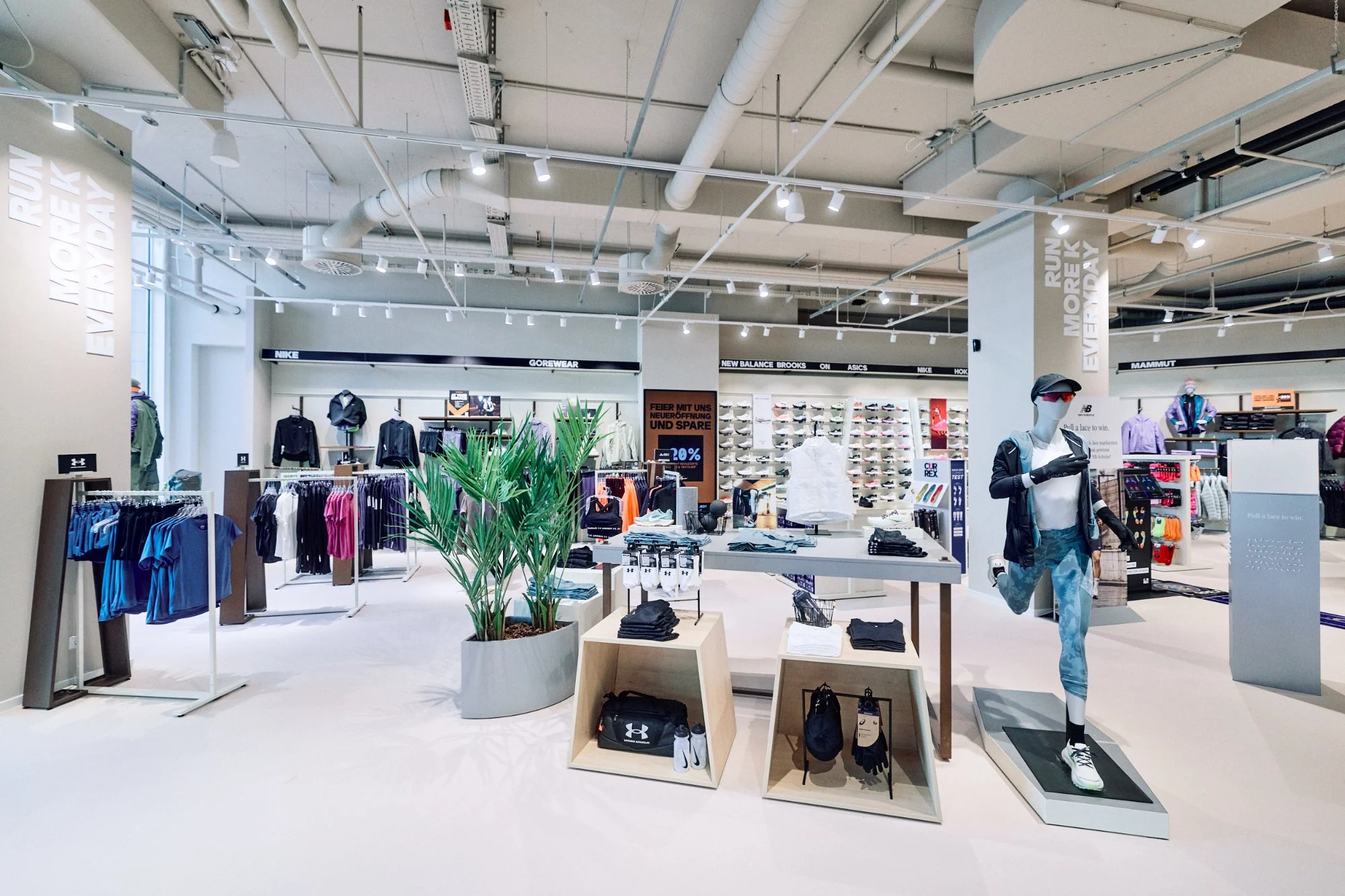
Flexibility. Modular furniture and reconfigurable layouts make it possible to adapt the space to launches, seasons and events without rebuilding the store. 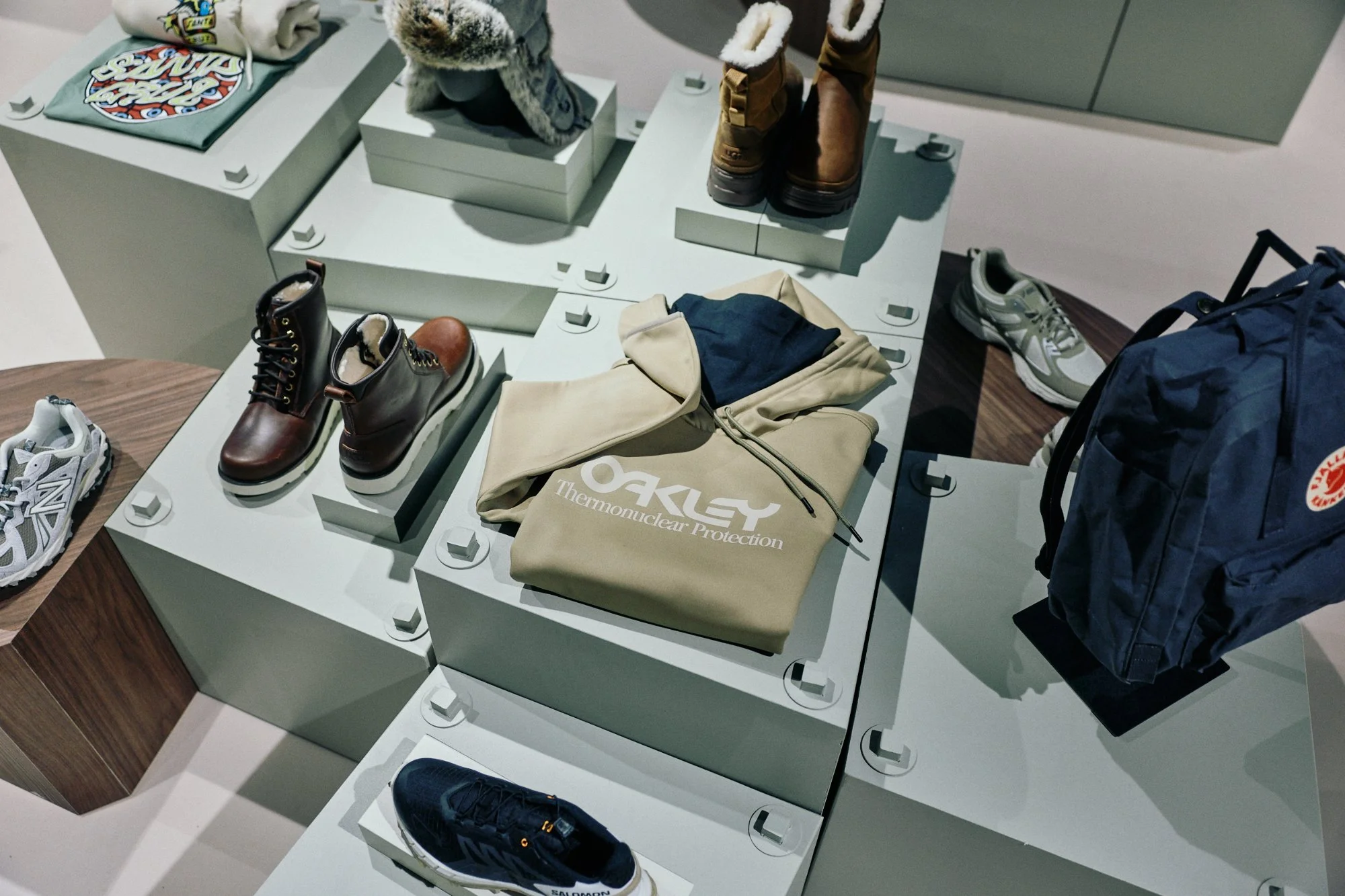
The store as part of the neighbourhood. The more a store is rooted in its context, the more it offers a reason to visit in person.
EUROPE: TWO SPEEDS
In Europe the picture has a particular feature. In major cities, retail space is in demand: according to JLL, notable store openings in Europe’s seven largest cities grew by 20% in 2025, and more than one opening in four involved new entrants, including brands born online opening their first physical store. Savills reports the first fall in a decade in vacancy across Europe’s prime shopping centres, to 9.1%, with Milan among the most sought-after markets: vacancy at 1.3% and rents up 8.1%.
Away from prime locations, the situation is the opposite. In Italy, according to Confcommercio, 156,000 neighbourhood shops and market stalls closed between 2012 and 2025, with clothing among the hardest-hit categories and the closure rate rising to 3.1% a year in 2025. In Spain, 13,586 small shops closed in 2025, more than a thousand a month, with rising rents cited among the main causes.
Physical retail in Europe therefore lives two realities: concentration on the main streets, desertification in neighbourhoods and mid-sized cities. Yet a well-designed venue can still change the face of a street, as happened with Luppoleria in Piacenza’s Quartiere Roma.
A REASON TO LEAVE THE HOUSE
The luxury crisis, fast fashion and the return to physical retail tell the same story from three angles. As after Marlboro Friday, consumers are more selective and weigh price against value. And as then, the brands that hold up are those offering something a lower price cannot replace. From the store, consumers ask for what a screen cannot give: a place to experience, a relationship, an experience consistent with the brand. Today retail design does not only create spaces to sell, but places that give people a reason to leave the house.
Frequently asked questions
Why are brands born online opening physical stores? Because acquiring customers online is increasingly expensive, while a store builds trust, relationships and new customers at a more predictable cost.
What is happening to the luxury market in 2026? Fashion and leather goods sales are slowing, especially in China, and many consumers no longer see prices as justified. Experiences such as hospitality and dining, on the other hand, are growing.
What are the retail design trends for 2026? Larger, more meaningful flagships, spaces designed for lingering, natural materials and warm light, flexible layouts and stores rooted in their neighbourhood.
What was Marlboro Friday and what does it have to do with retail today? It was 2 April 1993, when Marlboro cut its prices by 20% to compete with unbranded cigarettes and the stock market wrote the brand off. Brands responded by focusing on lifestyle and experience. Today, facing a new crisis of value, the response runs through physical space.

Recent Comments